The Problem with The Delhi Walla

Mayank Austen Soofi aka thedelhiwalla is a writer, blogger and a photojournalist. He has worked for Outlook, Hindustan Times and the Mint Lounge. He has authored four guidebooks on Delhi and one non-fiction book. His work revolves around Delhi, its lives and claims to present a Delhi that is usually forgotten or remains unseen.

There are a couple of problems with the kind of work Mayank chooses to do. He tries to encapture the life of Delhi that thrives and survives on the streets of the city. What is discomforting is how these pictures are so obviously not coming from the streets, they are just of the streets. Mayank’s lens comes off as a distant observer’s which fails to see its subjects as something more than the obvious. What makes it worse is how the conversations he produces are of the people on the streets of Delhi but these same people are never invited to be an active member or participant of these conversations. An appropriation of street culture seems to be taking its own life in his work since there seems very little or no narrative agency being given to the subjects of his work. What I am definite of is that this makes these conversations uncredible and hence, unreliable since the original narratives of the subjects are missing from the conversation. I wonder if the absence of narrative agency in the conversation and the overwhelming presence of an almost exclusively elite, urban, upper class audience which appreciates and celebrates his work does not make the entire act an act of scopophilia.

Apart from the fact that it’s unclear whether Mayank is seeking consent for all his photographs, there are a couple of other things that make this entire chamber of artistic expression seem a little eerie.

Mayank’s online feeds usually have a dominant theme revolving around the lives of the deprived. While it is easy to understand that happens because he tends to work a lot around areas like Nizamuddin Basti, Paharganj and Purani Dilli, what seems a little discomforting to me is that usually there is very little context to these pictures. What, then, remains to be considered a spectacle? The subject’s position of destitution. What makes this freakish is the way his images hold the power to objectify and isolate his subjects in order to calm the conscience of his privileged audience. Mayank’s constant production and recycling of poverty porn makes me question whether he deserves to be celebrated the way he is being celebrated and if to that extent.

Another running theme in his work is the obviously Muslim subject. It is fair to assume that is a result of his constant interaction with the area of Nizamuddin and the simultaneous development of a personal network. If you look at his work surrounding Muslim individuals and families, you would see that they are almost always clicked when they are engaged in an activity that can easily be identified as “something muslim”. What I noticed in most these images was how the muslim subject always ended up looking like a passive subject which, then, also made the images seem intrusive and personal (which incidentally bring us back to the argument of scopophilic photography). The frames and the treatment Mayank chooses does end up isolating the muslim subject into Muslimness.

Thedelhiwalla has a very joyful, enchanted way of looking at this city and its people which does the job of safely distancing his audience into passivity, immobilizing them from moving beyond primary consumption of the obvious.
Dear allies, step your game up.

Even though the Queer movement in urban India seems to be gaining momentum and queerness is finding more acceptance, allies of the movement and the community need to recognize the fact that we are doing it all wrong and when we do end up doing it right, we don’t do enough. When section 377 was read down, multiple colleges across Delhi organized celebrations on college campuses. While that is necessary, what I could not stop thinking about was how no one from outside the community was at the Supreme Court when the verdict was being announced. When we reached the Court, the only people present were either from grassroots LGBTQIA+ organizations or college queer associations apart from the community and their families. The day after, it broke my heart to see a guy marching in a parade with a sign saying, “I support my queer friends.” Though I understand the sentiment, signs like these are nothing but a constant reinforcement of how people are there in solidarity with the queer movement and nothing else. Straight allies are so afraid of being mistaken for being queer which, I think, is nothing but internalized association of abnormality to queerness. Cis-Het allies need to normalize being and being seen as queer. We must stop distancing ourselves from a queer identity while engaging with the queer movement, that can not be considered a form of self protection.

Allies need to understand that their support is needed on the bad days, not only on the good days. You can be there to get your face painted at Pride and hold hands with your Queer friend but how is that of any help when you aren’t there to comfort them when they receive hate? You must use your privilege to stop homophobia from existing and if not that, then stop it from materializing into tangibility. However, it is just as important to know when it is not your place to speak. I see so many straight allies constantly interrupting and speaking over queer people. It is not your place to speak. You are not the saviour of an oh-so-miserable world. You are not allowed to overtake and co-opt people’s own narratives. Your job as an ally is to use your privilege to create a safer space for the community for them to find, present and magnify their own narratives. You cannot and should not be in a position to lay out or even slightly influence narratives that come from within the community.

Lastly, please do not put the burden of education on queer people. It is not their job to educate you on the nuances of non cis-het identities and existences. If you want to know something, read and learn on your own. DO NOT use queer people as a source of extraction, it is disrespectful and exploitative and there is a very high chance you are exhausting them.

Most importantly, allies need to stop thinking very highly of themselves just because they are not delegitimizing someone’s existence. It is basic human decency and being kind to people does not make you a higher mortal.

Delegitimizing Female Friendships

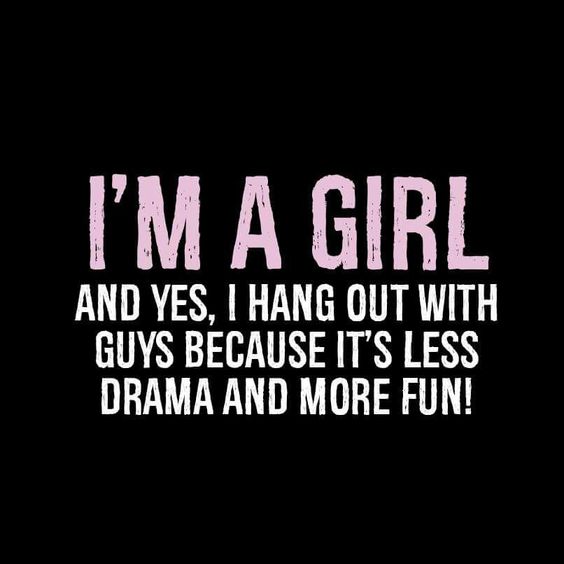
When I entered high school, I was forced to internalize the idea that all women are “too” emotional and thus, way too much drama. Guys, on the other hand, are the cool ones, the chill ones, the fun ones. This was reinforced by the sudden bombardment of online content that consistently created a “crazy girl” trope wide enough to fit all girls and glamorized the one girl in the group of guys. The images attached are just some of the many.


Most of the girls in my school eventually ended up looking for friendship exclusively in men. The one girl in a group of four men was considered “cooler” than an entire group of ten women. What this ended up doing was creating a condition where only boy friendships were legitimate and teenage girls had to constantly look for masculine associations in order to validate their presence and worthiness.

Conversations that constantly delegitimized womanhood and vilified femininity ended up making girls conscious of themselves and made it much harder for them to figure out who they are and where they belong. They were constantly provided only two extreme positions, neither of which created a natural habitat for girls because they were made to feel like an outsider in both of them.

Existing gender hierarchies led to the production and dissemination of such images that not only pushed femininity and womanhood to a lower pedestal but also considered women as sub-human. These conversations presented men as higher mortals, the worthier ones. This eventually conditioned teenage girls to believe that they are not intelligent enough, not competent enough, not worthy enough. We were forced to run after an ideal that was not meant to be chased.

There are a couple of things to be dissected here. Firstly, women are constantly told they are worth nothing if they are not associated with a man or men. This leaves very little of the girl herself left because they are constantly adapting herself to fit better into a man’s definitions. The process of devaluing a woman’s existence starts so early that it slowly and constantly erodes and corrodes what they really are. In addition to that, girls are taught to define and measure their worth according to a man’s yardstick and since men are men, women learn to think lowly of themselves. Secondly, and most importantly, it normalizes abuse in women’s lives. Since we have been conditioned to consider ourselves unworthy, it takes a lot of time before we actually come to demand basic human decency from others for ourselves. This means we take years and years of abuse thinking we deserved it or we did something to cause it or that it happened because there wasn’t another man around.

I am eroded and very little of me is here. I try to create a better world with whatever I have and hope that is our saving grace.

The Obsession with Convenience

In a conversation I had two weeks ago, a friend asked me if it’s necessary to take a decision if it is a difficult or an inconvenient one. It got me wondering about the acceptability of the grey areas. I am not looking for answers from this vomit of a thought pool, neither am I looking to give any answers. All I hope is to maybe bring the one reading this to a position where they know where their decision is coming from and what it’s consequences can be.

I completely understand and respect when people choose not to fight at the expense of the self. I know how exhausting life can be when you make your politics personal. But is there really expense to be borne by us when we are so distant from the equation of violence that we are able to be ignorant and indifferent? Or are we really facing the exhaustion of a personal politics if we are able to choose to not fight and struggle? Assuming, then, that this position of distance always comes from a secure location then I wonder if it is okay to protect your self at the expense of someone else’s. Can we, assumably sensitive humans, choose to distance ourselves when our indifference will very likely and very directly harm another being? Can that choice to be ignorant and centrist, then, be called an act of self protection? What if and when there is lesser possible harm to be borne by us? What when we are not directly engaged in an equation of violence, which then affords us the privilege of comparatively lesser damage, if we do take a hard stance against an abuser of power or an oppressor?

What when our positions of privilege sanction for us some amount of social and institutional safety and security? Do we, then, hold the responsibility to participate in the struggle and also create a safer space for the ones struggling not by choice? If our actions might cause us very little backlash then must not we do some good? And what if choosing to not do this good means doing someone bad? Can we afford to prioritize our convenience over someone else’s misery? Is it really ethical if we look away from someone who needs help just because we do not want to be in an uncomfortable situation? Can we really say our life is worthier than someone else’s? But most importantly, can we call ourselves “good people” if we are all who matter to us?

Comedy and Politics, or the lack thereof

As politics becomes more personal than ever and activism enters spheres of the domestic life and the self, the comedy that claims to reside in and arise from human actuality fails to catch up. While Political Satire and Political Comedy seems to be gaining momentum and becoming a subculture industry in itself, mainstream comedy is taking a hit. The big names of this industry like Jerry Seinfeld and Bill Maher have talked heavily about how Political Correctness aka PC Culture will be the death of “good” comedy. The argument that comes in is that comedy speaks truth to power and thus, restricting it with what is okay and what is not then makes it another establishment as well and also reduces its capacity and power to talk more freely about anything and everything.

However, what is absolutely necessary to be talked about is whether this face of comedy can really be considered “good” comedy. Can someone be considered competent if they choose the easiest and least effective way of doing their job? Comedians who make the conscious decision to take a jibe at the historically marginalized and ignored are, then, navigating what makes the privileged and the ignorant feel at ease which, to be honest, isn’t that hard. When they reserve an entire stand-up slot to insult how disruptive personal activism is, they try to console the consciences that are brought to unrest by communities disrupting systems and structures of oppression. They are telling the ignorant that it is completely fine to be indifferent to other people’s struggles because the struggle is the butt of the joke anyway, that political movements are going too far and are basically impractical now, that it is okay if you can’t make sense of it because that isn’t your privilege interfering but it is just that activism does not make sense in itself. They reduce the conflict of political activism and passivism to nothing but convenience. This, then, becomes a space that convinces people to only resist and deconstruct oppressive structures when it is convenient to them. And guess what privilege brings along with it? Safety and comfort. So, there is a huge chance that this audience and this comic circle will never step out of their comfortable existences and for sure, never for someone else.

Mainstream comedians argue that they speak truth to power but are they doing that at all? Are they questioning the institutionalized and systematic structures of oppression which are the medium of creating and maintaining power centers? I, personally, don’t think so. All these comedians are doing is furthering means of oppression and further marginalizing the already marginalized by making fun of and being insensitive to their histories of oppression and then delegitimizing their movements and narratives when they rise in resistance.

But most importantly, it is absolutely essential to see the kind of world this anti-activism front of the comic space is demanding. When comedians take the stage and make the rise of activism or political correctness the butt of their joke, they further the idea of political passivism. What these comedians, then, are asking for is a less political space, a less political world. It is easy to notice that a stand for less politics can only come from a privileged position, an identity location that has not been politicized for you. What they are arguing for is less sensitivity, love and kindness for those who come from histories of hurt and trauma.